Issue 15
"Never forget: Individuals and interactions over processes and tools"
LLMs can increase velocity, yet teams still win or fail on human interaction.
By Martin Drohmann
Published

Issue 15
LLMs can increase velocity, yet teams still win or fail on human interaction.
By Martin Drohmann
Published
In 2001, seventeen software developers looked back at some very expensive software projects that failed miserably and tried to come up with simple principles that might have prevented them.
The result was a list of four surprisingly simple values. The first value reads: “Individuals and interactions over processes and tools”.
It is now 25 years since those developers wrote the Agile Manifesto, and after speaking with several people in different companies lately, I wonder whether its lessons are being forgotten. After all, there is a shiny new tool out there, addictive, magical and seemingly powerful: LLMs.
The Agile Manifesto made quite a splash and led to the widespread adoption of some, well, tools and processes. Kind of funny… But these processes, such as Scrum or Kanban with cyclical rituals, reminded teams to come together and interact with each other on a regular basis. Gergely Orosz, the author of the famous newsletter “The Pragmatic Engineer” recently reasoned how much those practices brought efficiency improvements to many tech companies over the last two decades.
Now with LLMs that emulate human interactions, even rituals can be automated away. Why not just let the AI look through the backlog of issues and create a summary of what needs improvement?
Product and engineering managers can create work for their teams at a scale that was previously unheard of. It allows for micromanaging at scale, where all decisions are initiated by one person (and an LLM), while contributors stay busy with tasks and the ever-changing question: How much can I trust this LLM to write the code?
Of course, it also makes siloed development much more possible, where a single contributor can create an impressive project that makes it into production, with the design and execution process living mostly in one person’s head.
But in both of the above cases: Is the larger output of lines of code really due to the impressive capabilities of the AI, or due to the sidestepping of critical questions and important conflicts?
What is scary is not that all of these scenarios are possible. What worries me most is that, after talking to several people in different companies, I see signs that some are already happening. And engineering departments are just the tip of the iceberg.
Many operators feel pressure to use LLMs as much as possible so they do not “fall behind,” but hopefully not like this imaginary (AI-generated) company here:
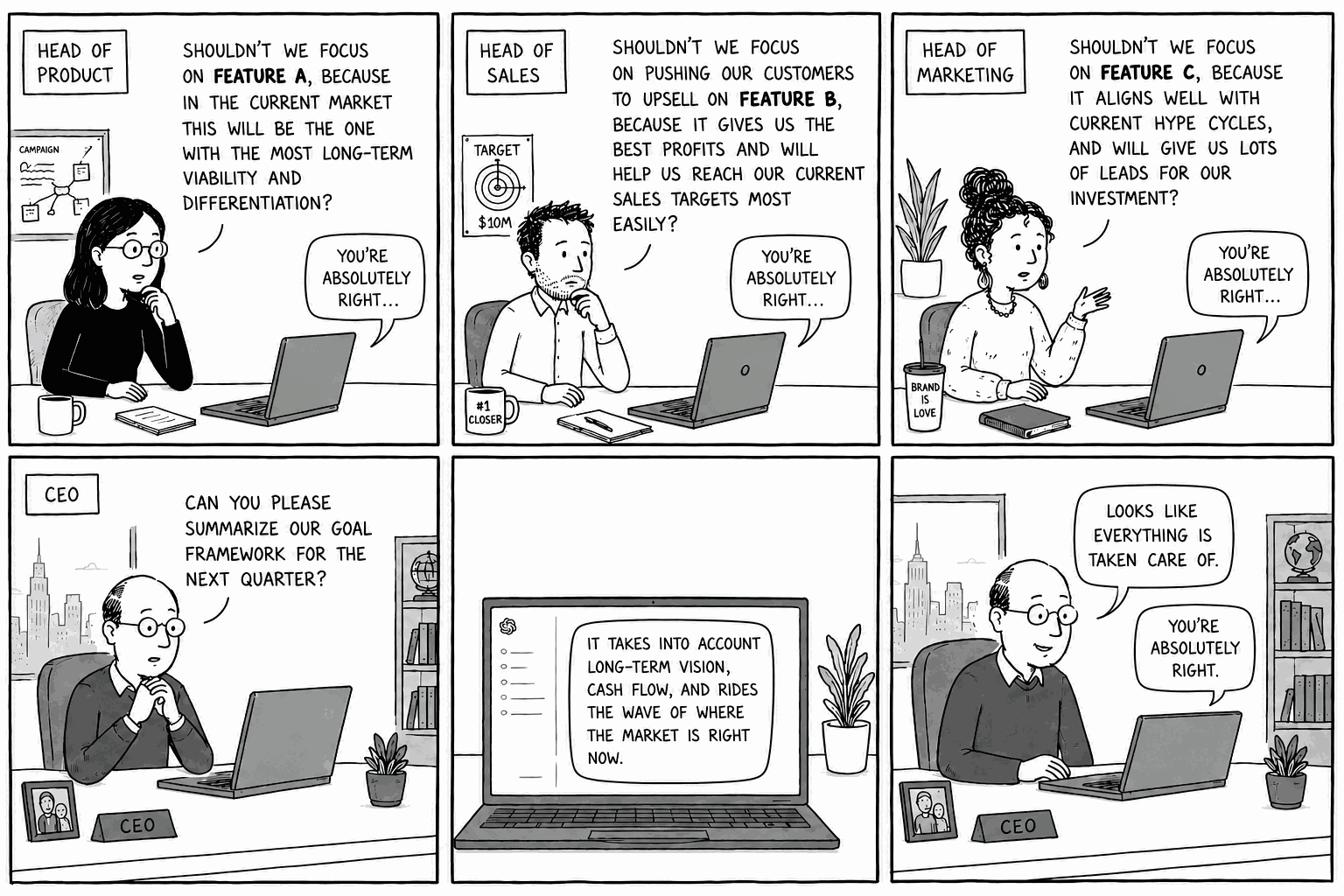
We all know that friends or employees who always tell you, “You are absolutely right,” may be the least helpful voices to rely on.
If you agree or you think that you could use some help figuring out how to use AI to improve productivity and nourish the essence of what your company is about (humans and their interactions), feel free to reply to this newsletter or send me an email.
What interactions do you outsource with AI, and are you aware of the consequences?
With care,
Martin
If you want to receive a weekly reminder of where to look for leadership obstacles and tips how to prevent them, sign up to my newsletter here